Friday, April 8, 2011

A Story-teller's Sabbatical


Zero

The trip was meant to be a sabbatical.

They told him, it will do you a lot of good. A story-teller is always on a sabbatical is it not, he asked. You are not a story-teller, they replied. I am not, he agreed, maybe, maybe not, he added. Whatever, they dismissed him. Who is not a story-teller, he wondered wandered alone.

Some story-tellers try to write. Some become a postprandial raconteur. Some shy away from an audience. Some prefer to listen, to judge. Some try to forget their stories. Some hide theirs. Some pretend to be otherwise as if there are no stories to be told. Some assume that their story is a test quite meaningless without a grade. Some appear to know it all. Some simply ignore. Some gather kindred souls to ostracize, discourage, restrict, censor. But, stories can escape from solitary confinement. Stories might not even end with death.

Images, memories, experience, sensation, passion, thoughts, ideas…

Lover, loner, rapist, father, spouse, partner, polygamous, androgynous, misanthrope, sensual, greedy, devoted, rake, sexual, impotent, psycho, fanatical, dependable, villain, hero, anonymous…

A million lives to be lived in one…


One

When the bus crossed the state-border, he expected and waited for change.

He noticed the pigs, the overflowing garbage and the blocked drains. He took in the other differences: the shade of skin-colour, language, volume and tone of conversation; also, the new smell of people, place and air that made his nose twitch. The dress and demeanour though similar, of course, looked strange.  

He waited, breathing slowly, acclimatizing. For him, these days, the ‘acclimatization process’ usually took only fifteen minutes, or utmost half-hour – for his senses to match with that of a local. He knew that the changes were often virtual, a result of his expectations or desire to be different when he crosses any state-border.

Recently, he had started feeling like a stranger in his own land. He tried to overcome those attacks with the same ‘process’ – waiting, breathing slowly and trying to feel like a local, at least at home.

The thought of a distant past, of those days when he had shifted from Bangalore to Bombay, made him smile. He recollected how it took him more than three months then to even notice and appreciate women in that new city. They had seemed different and unappealing. Even the street dogs had appeared different. The Bombay ones looked like lovable pathetic characters. The Bangalore dogs he remembered were strong, muscular and waiting to be a man-eater.   

He was brought out of that reverie when the bus came to a jarring halt. By the time he got out of the bus, he felt only mildly strange in that new place across the border where he had a two-hour wait for the next bus.

Two

At that first stop, a bus-station close to the southern tip of the country, a man was shouting at his wife. The woman looked very young, late teens probably; her husband a few years older.

They were part of a group of contract workers going home or to the next place of work. A few men in that group were drunk, with dhoti hiked till the upper thigh, swaying in the still late evening air. They told their colleague or friend, that husband, to be quiet. The husband ignored them and pushed his wife roughly. He shouted at her for money.

The wife maintained a sullen silence. She squatted on the ground, guarding their meager belongings. The husband raised his voice, telling his wife that he needed money to get something to eat and not for alcohol. She ignored him, or at least tried to, till he pulled angrily and roughly at their bags.

She reached within her blouse and took out a five hundred rupee note. He screamed at her again and told her that he wanted change. She reached within her blouse once again and brought out the rest of their savings, two ten rupee notes. He snatched the five hundred rupee note from her small hand and also grabbed one of the bags, presumably his belongings. He hitched up his once-white dirt-smudged dhoti, stuffed the note in his shorts, scratched his groin and glared at her. Then, he took that note out, crumpling it in his hand, taunting her. He shouted at her, told her to get lost, that he did not want to see her ever again. He marched off in the direction of a liquor shop.

The woman sat alone, a little away from the rest of that group. Her dark unblinking eyes followed the back of her husband. Her young lips did not quiver, her jaw remained firm and, her smooth dark sunken cheeks remained as they were, without tears, whitened by smudges of powder and dust. She looked lost. She did not bother to stuff the two remaining ten rupee notes within her blouse.

A few minutes later, a bus arrived and that group of contract workers entered that parked bus. The woman remained seated on the ground, holding onto her bag, looking in the direction in which her husband had gone.

The tableaux remained the same till the bus started and got ready to depart. The husband entered the scene then. He stood in front of his wife, glared at her and grabbed the bag she was holding. He shouted at her, about how hungry he was. He blamed her and told her that he could not get anything to eat with that five hundred rupee note. He gave her the five-hundred rupee note, untouched by others, unused, crumpled. She slipped it within her blouse, treasuring it next to her small firm bosom.

As they moved towards the bus, she gave him the two ten rupee notes for the bus-tickets. They touched briefly, then. He stood behind her in that departing bus, his arms shielding her.

Three

An eight hour trip followed – punctuated by some stops and bright lights, silhouettes entering and fading within or without the bus and, a visit to a filthy wayside Pay and Use urinal. He should have pissed in the open, like the others. He should have saved three rupees and avoided olfactory, visual and unhygienic abuse.

When he reached his destination at 05:30, he noted that his Lonely Planet guide-book rightly describes ‘there are few more refreshing … moments than boarding a bus in the heat-soaked plains and disembarking in the sharp pinch of a … night.’

Before 06:00, he was in his hotel-room. He stripped and dumped his grimy travel clothes in a laundry bag, washed his face and hands, wrapped a bath-robe around his naked body and stepped out onto the balcony.

He watched the early morning light creep across the lake, rippling the water and nudging life into the sleepy air, lifting a light veil of mist.

He looked around. The balconies on his level were empty and the rooms dark and quiet with heavy slumber. On one balcony at the upper level, that of the suites, he noticed a lone figure. The lady was in her night-clothes, quite inadequate like his in that chilly morning air. They looked at each other for a few seconds before looking away.

Later, during his stay there, he saw her twice. They were then both deeply veiled behind the purdah of matrimony or propriety, and they had walked past each other like strangers who had never shared anything.

That first morning, they had shared the same scene in that early light; they had listened to the same birdsong; they had felt their nipples stiffening as the fresh cool touch of chilly morning air on naked skin started at the bare toes, up the legs, over the navel and torso, caressing lips and hair; and, they had breathed in the same air with that faint tinge of eucalyptus.

They had looked at each other once more before going back to another life inside.


5:54 AM                                                               6:30 AM

 
Four

Mid-morning brought the first blues. The usual life and routine had a protective allure. He thought about entering an internet cafĂ©. But, he walked past, without even a furtive glance within. The mail not seen, the mail not sent, hoping, avoiding an empty mail box, depending on the other’s sixth sense. Fool!

Five

He left the main road, past the usual sights. He felt someone following. He looked behind him – he saw no one. He made a sudden turn to the left, on a gravel footpath, with a steep climb on the right and a never-ending fall on the left. He battled against vertigo, moving forward slowly, his right hand feeling rigid comfort, his left tucked in a pocket, shrinking away from the airy expanse. He listened to the crunch of gravel. It could have been the echo of his footfall. Or, it could have been that of the follower.

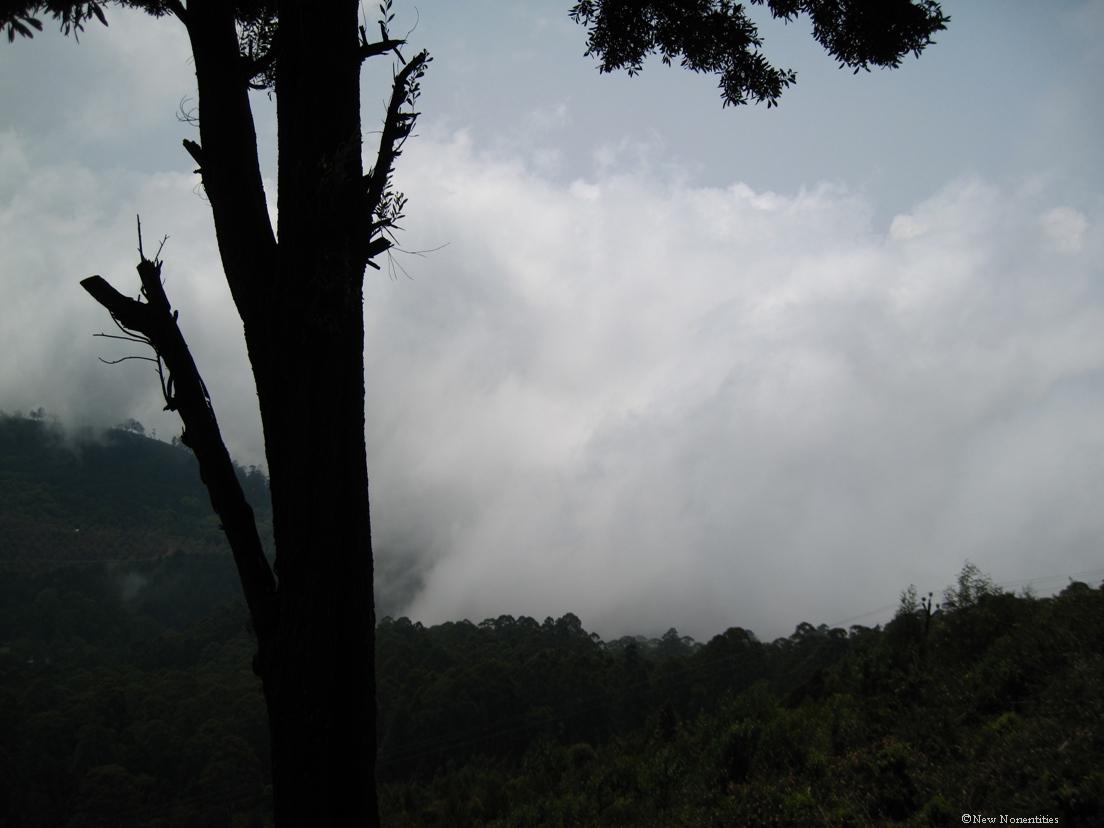
He reached a turn in that unfamiliar path. A tree blocked his way – a familiar tree on that unfamiliar path.

Trees have stories, too. Long ago, two lovers dreamt of lying beneath this tree. The man gripped the black thread and the locket lying between her full breasts. Remove it, he suggested. She shook her head. His hand strayed from her breasts to her neck, to her navel and thighs. The clouds were beneath them, the heavens too. They wanted to be wild and forget the world around them. What are you thinking, he asked her. She smiled shyly slyly and remained silent. Let me guess, he said. He told her about his dreams, about a trip to such hilly clime, about making love beneath open skies, or within a tent, beneath this tree. Did I get it right, he asked. Yes, she said. He kissed those lips that had uttered a lie. They needed such lies and they built their love on that. With the little time they had, they could not have done a better job with truth.

He leaned against the tree, hearing no more footfalls behind him, fearing no more the fall in front.


Six

That afternoon, he entered a steam bath and tried to exorcise all the demons within. Each drop of sweat carried months of self-imposed thralldom.

From the health joint, he walked to a tobacco shop. He asked for JPS. They didn’t have that. He settled for his old usual. The shop-boy gave a cheeky grin and charged much more than the MRP. It didn’t matter to him, not on this trip. He went to his room, ripped it open, after reading the warning, ‘Smoking kills. Tobacco causes cancer.’ He lit a cigarette and felt the harshness of the first take. He sat motionless, watching the tip of ash grow. Loneliness kills. Solitude causes emptiness.

Seven

After tea, he tried the 5-km walk around the lake. Including photos and aimless pondering, it would take him about an hour, he calculated. He realized that the best part about places with nothing much to see is that it allows him to see that he really wants to see.

Along with the first beautiful sight came a bitter thought – he was surprised by the vehemence of that un-exorcised demon.

She and her folks had decided to ignore him, he remembered. They had collectively decided to think wrong of him. Like the aftermath of a forgiven extramarital affair, it will all be fine soon, everything will appear just fine. But, just like the situation after that affair, the relationship will never be the same ever again, never forgiven, never forgotten.  


Eight

He walked past happy couples, parents and kids, nearly all holding hands laughing cheering, except for two young foreigners. They walked with long purposeful strides, discussing a research topic. He saw them later sitting together in a secluded part, still talking, now with a hushed soft tone, with their feet nearly in the water.

He liked walking against the crowd. He smiled at a newly-wed couple, struggling to get it right on a tandem bicycle. They smiled at him, nearly giggled. A young enthusiastic mother went past him following her young child on a cycle. A man, the father-husband, dragged his feet behind them, pouting his lips, serious and silent. A little later, he met another young family. There, it was the mother-wife who sulked. He should also try to be serious and silent, he decided, just for a change, for a laugh.


He stopped at a locked gate and looked up a path with roughly hewn steps. He could feel those steps beneath him, the climb to that lonely cottage at the top. He thought he could hear the quarrelling, the bickering, the nagging, the recrimination, the thud of slammed wooden doors and the reverberation within the deep green. He could nearly see the feet running down that path, slipping, hurting, hands opening the gate and shadows racing past him, shouting loudly harshly at the other following close behind. He felt a cold silence after, as if those ghosts had sucked the air and created a vacuum around him.

He followed them to the old abandoned boat-house, shackled and forgotten. He could see that ghostly couple enact out their own version of Rebecca. In their story, it would be without the refreshing and loving second chance. There will be no Mrs. de Winter for that despondent barely surviving Maxim de Winter ever again. The man held her head beneath the surface of water, counting the bubbles till there were none. That is where they lost love and decided to believe no more.


Nine

He walked away from that boathouse, away from that memory of a second trip that never happened. He walked fast.

That’s the only problem with these 5-km circuits, he thought. It is tough to get away when you are in the middle.

Another memory lashed at his senses, a memory from his first trip to this place. He felt weak in his knees, a bit breathless. It was a bright and beautiful cool evening. Was he sweating, he wondered.

He was a young boy then, walking alone around this lake. His older siblings had gone ahead on bicycles, laughing, telling him to catch up with them soon.


He must have reached the turn in the path. He must have been looking at the tree house. A respectable-looking middle-aged man was peeing behind a tree. Grey hair, prim and proper, he could still see what his young eyes saw then. The half-sweater over long-sleeved shirt, a pant with well-ironed creases, polished shining black shoes; and, those stern eyes staring at the young boy, like a predator eyeing a prey. The man’s left hand was holding his penis and with his right, the man waved at the boy, beckoning him to come close.

The tree on one side looked like that man’s hand, reaching for him. The tree on the other side will remind him of the shadows reaching over him, over the water, engulfing, incarcerating and dragging him into those depths away from innocence.


The young boy ran away. He knew the man would not chase. But the boy did not stop till he reached his siblings. They were resting on the green slopes, having an ice-cream. He had felt weak in his knees then, sweating profusely, too. Seeing him in that state, his siblings had asked him, what happened. Later, when they joined their parents, they asked him again, what happened. He kept quiet. Young boys were not supposed to talk adult stuff.

Now, decades later, he had the same fears. He walked away. He could not run. Maybe, when memories are just stories, he thought, they will be easier to live with.

Ten

On the second morning, he set out on a sight-seeing trip along with a motley group of serious kids, hyper-excited parents, stout wives and thin husbands.

The trip started late. Everyone expected that. He tried to mimic the stoic expression of the other passengers. But that scene with admirable sang-froid suddenly changed and soon got taut with tension. The Christian driver explained the situation succinctly and disappeared. The people in the bus realized that the delay was due to two over-sleeping Moslem kids.

Seated next to a fat Hindoo, he precariously hung on to his small narrow seat and every spoken word. He listened to the curses and the outrage expressed within that tempo-van. Everyone had a root cause ready to explain the problem. Ancient and new culture; new and black money; the majority made to give all to the minority; and, even the beard of the errant kids’ father joined the list of causes. He tried to think of a suitable contribution.

When the two bleary-eyed over-slept kids entered the van, they were met with stony silence and dirty glares.

At the first stop, he relaxed and admired the scenery for too long, feeling comfortable with the company of surprisingly benign well-mannered non-human monkeys. This time, when he entered the van, it was he who was met with stony silence and dirty glares. The silence seemed to echo all the complaints against Mallus that must have been aired while they had waited for him.


At the next stop, the group got out, ran down a moderate slope with innocent exuberance and climbed back up feeling as if they were paying for past sins. They felt good when they returned to the van, huffing, puffing and breathing hard. The exercise is good, they all said.  The driver-guide suggested another spot to the group, great for a nice trek, he said. The group laughed, smiled, hum-hawed and shrugged their heavy shoulders and gut. They prefer to stay close to the van, they all said. That helped to keep the trip short and sweet.
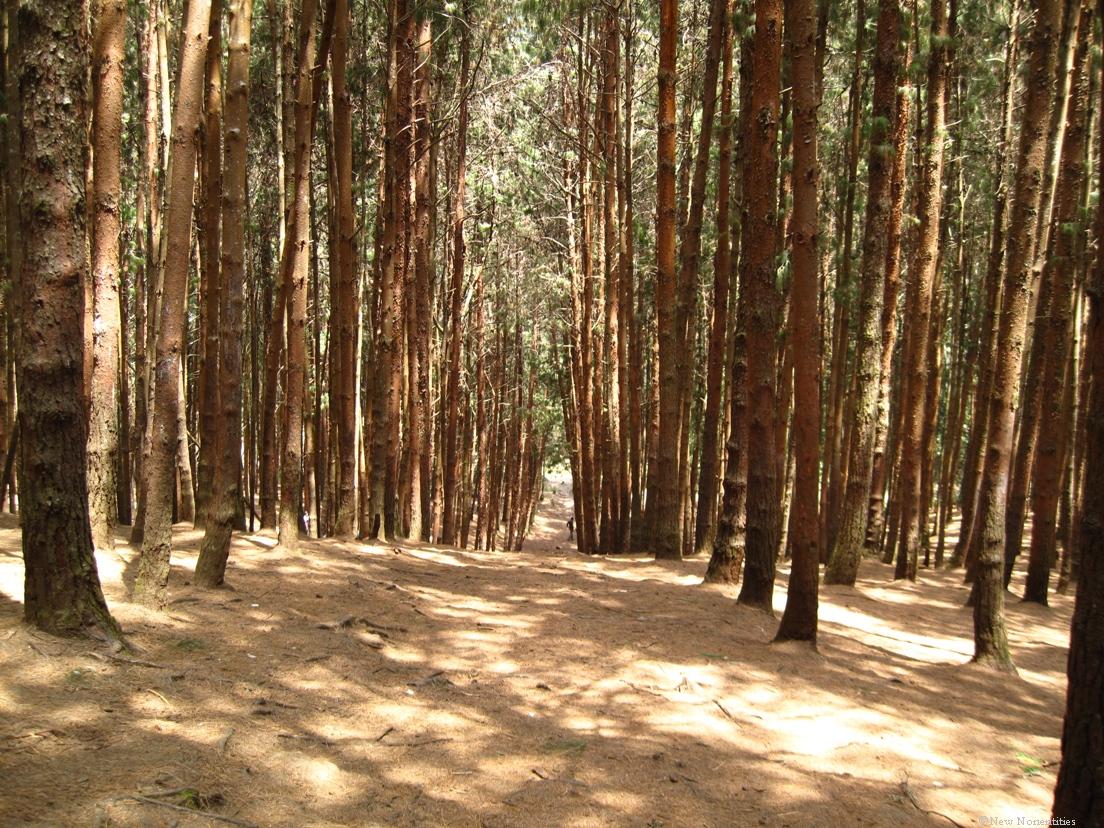
At that second stop, the Sardar family in the group got lost in a film-shoot on that tiring slope with never-ending rows of pine trees. This time, he joined the rest and cursed Sardars. That Sardar family looked apologetic when they returned but he and the rest received them with stony silence and dirty glares.


On the way to the next stop, the driver apologized for the Forest Department. The inconsiderate department had closed the way to Sue Zed Point because it became too popular, the driver explained. But, try the next spot with the two pillars, came the helpful advice. If it is not cloudy, you can see the way down, the driver-guide advertised.


At that stop, the lot from Bihar went missing for a long time. He along with the Sardar family, the Moslem kids and the rest joked about the end of Biharis at Sue Zed Point. When the Biharis returned, the whole lot forgot the jokes and greeted them with stony silence and dirty glares.

He mastered the rules of the game before the 3-hour trip got over. He took the initiative in gathering the majority within the bus and played the game with vicious delight. Together, they treated the last ones to enter the bus the way anyone should treat any inconvenient minority.

The driver-guide kept his choice of shops for the last stop, Sir Madam, here you get pure eucalyptus without kerosene, fresh chocolate daily change, of course, you should buy only if you want to, he implored the group. At that stop, everyone got back late to the van. They forgot to play the game. When it comes to commerce there is no majority or minority, he noted his left-leaning thoughts with rightful distaste on a disposable scrap of paper.

Eleven

On that day, mid-afternoon brought the blues.

He thought about another trip. Abroad, attending a summer school or conference, on a measly official allowance, he recollected. He had managed to get a telephone card. Precious little card, limited and irreplaceable, beyond his means actually.

He had called her. Her father had picked up the phone. Casual chit-chat followed, formality made him ask for her mother, her sister, her brother and the minutes slipped by. Finally, he could ask for her. She came to the phone. He heard her say, Hello. He heard her breathing hard into the phone. He held the phone firmly, roughly, nearly squeezing, as if it was her. He asked her, How are you.

The telephone call ended. The card’s life was over. He never got to know her reply.

Twelve

He was still in the same state that evening. Cigarette stubs, full ashtray, watching a movie with unseeing eyes. It was a movie about a letter in a bottle thrown into some deep dark water.


He has this box of unsent letters at home. On top, there is one to a friend he has known all his life. Nearly all his life, he corrected, he didn’t know her till the age of four.

That time, so long ago, he had received a letter from her. It had taken months to reach him, trying to follow and keep pace with his nomadic travels.

On that night, he had had a dream in which she was in trouble. He got up in the middle of the night. He wrote a long reply to her letter – wishing her well, filling the pages with care, thought, purpose, praying for her. He signed at the end, beneath ‘With lots of love’.

He did not send that letter, wondering about what she would think. It remained in the box with the rest, unsaid thoughts that meant a lot more than all that he has ever said, then, before, or later.

Thirteen

Around the time dusk bade farewell and night knocked lightly, he entered the near-empty bar, strangely a bit too early to be empty. He played with a peg of his favourite, for old times’ sake, he thought.

A young man sat on a stool two seats away, sporting a sardonic or wry smile and hazy eyes, downing mugs of beer, chasing it down with whiskey more frequently. The barman looked at them, shrugged his shoulder, polished glasses and wiped the bar-top.


A bar is like a train at times – strangers become bosom buddies for an hour or so, then forget and leave.

The young man told him, without any preliminary, about a beautiful lady he had met. He had helped her carry a heavy bag of shopping from the departmental store to the bus stop. For the first time in his life, he had gathered courage and decided not to let the opportunity slip. Before she boarded the bus the young man told her, I would love to have coffee with you some time. He had been stunned when she said Yes let us meet at the café coffee. She had suggested, how about 4 pm tomorrow.

The young man had dressed well and he had reached café coffee early. She was there even earlier. The young man told the rest after gulping a mouthful of beer. She asked me to join her and her husband, the young man recollected and continued, I had coffee with them and left quickly. I think I heard her laughter behind me.

Fourteen

A loud cackle, followed by the rough gurgle of phlegm, from behind him brought that discussion to an end.

He and the young man turned to see an old man nursing his glass. Rough shawl draped over narrow stopped shoulders, creased face which had seen many summers, a crooked toothless mouth sucking greedily at a beedi – the old man looked fit to be a stereotype of the veteran bar occupant.

The three maintained silence for a few minutes, interrupted by loud slurps, burps and careless farts. He settled the bill with the barman and stood up. That is when the old man grabbed his wrist and asked him, do you believe in ghosts.

When love dies, ghosts appear everywhere, the old man said. He continued, you will see a ghost, you will say, that is her hairstyle, that is her figure, her way of walking, the dialogue sounds familiar, the situation and the meeting places all remind you of another time, another place. But, there will always be disappointment at the end, the old man concluded, that is what ghosts do to you.

He broke away from the old man’s grip and got out of that bar.

Fifteen

He entered the restaurant. He was shown to a good table. He had a mismatched supper of soup, fish and chips, and chocolate mousse. He ate the fish and chips with style and finesse, using the proper knife and fork, wasting little, all properly done.

He remembered an old visit with a best-friend to Indian Coffee House. He had struggled to eat the mutton cutlet with fork and knife. He had stabbed, pierced, chased the pieces, spilled and finally, he had stooped low to get the pieces in his mouth rather than to get the act right. His friend had suggested, use your hands, dummy.

He had learned later, how to eat, how to be proper. Along that path of time, somewhere sometime, he and that best-friend had parted ways, and he preferred to eat alone. He could not remember why or when. That is one story he has managed to forget.

Sixteen

A young couple sat at the centre-table.

A waiter placed a vase with a beautiful rose on their table, right in between them. The man removed it. They looked at each other, oblivious of the world around them. That will probably be a moment they will store for years, among the good ones. They will talk about it. It will help them forget the unspoken bad times.

Her sari slipped. She knew that her husband was looking at it slip a little on the right. She knew he loved to see the mole above her right breast revealed by her low-cut blouse. A few seconds passed before she covered it and arranged her sari. She knew that her husband wanted her to do that, too.

Seventeen

In the special area between the main dining hall and the lawn, an elegantly-dressed lady and her teenaged daughter were discussing the latter’s projects in school, probably the International school there. The daughter talked about her boyfriend’s thesis on Macbeth, about how the play revolved around the carefully concealed extramarital relationship between Duncan and Lady Macbeth. The mother smiled at the idea. We have The Merchant of Venice too, the daughter complained. The mother leaned forward and picked up the daughter’s textbook. We used to have a censored version, the mother noted. Oh yes, the taunts, the vulgar, the stones, the anti-Semitic parts right, the daughter affirmed. Her boyfriend had told her about that too, the daughter informed her mother.

The father joined them. The textbooks disappeared from the table. The father called the waiter and enquired about the wine-list. For a minute, the waiter tried to sell his wares. The waiter failed to observe the sneer developing on that father’s face. Later, for seven uninterrupted minutes, that father educated that waiter and his boss, the head-waiter, about what was lacking in the hotel’s wine-list and where and how that father had had the best. The waiters listened respectfully.

The daughter rolled her eyes on the sly. She smiled at her mother, a quick smile. The elegant lady sat with great poise, expressionless.

Eighteen

Next morning, he woke up with the pitter-patter of little kids’ feet outside the door. Every morning, the hotel staff managed the fun-hours for the kids and they took exceptional care. The kids loved the clowns, the amusement, the games, being away from their parents with whom they will later tag along, get cuddled, smothered, scolded, instructed and coochi-cooed. They had two hours of their own, with their own kind.  The parents had two hours of their own, too; sometimes separate, sometimes together within or without locked rooms.

Nineteen

The staff always greeted him cheerfully. He tipped generously. It has been a long time since he stayed in such places. When the staff started to greet him less cheerfully, he wondered about his generosity, whether it had kept in touch with the times. Since it will be a long time till he stays in such places again, he stopped tipping. He stopped thinking about cause and effect. Causality is tough to prove, correlation is easy to calculate, his final thought on that subject.

Twenty

He loved walking, on clean footpaths, without sweating, wearing a light jacket, munching fresh chocolate, sipping soda, watching a game of soccer on the school ground and listening to kids from every part of the globe cheering their team. Foreign kids do not pick up an Indian accent, he noted. He likes to speak but he tries to speak very little. Indians find his accent laughable, he knows. Foreigners think it is quaint.

Life around him moved in slow motion – visible, carefree, laughable life.

Three unrelated couples walked on the footpath on the right side, avoiding people and at varying distance from each other.

In front, an Indian boy and his South-east Asian girlfriend walked together. The girl’s arm was around the boy’s waist, the boy had his arm on her shoulder. Once or twice, the boy kissed her, on her hair or the side of her forehead. Each time, they laughed after the kiss.

Behind them, a young married couple walked, talked, hardly noticing anyone else. They held each other’s fingers. They looked at each other once or twice, smiled sweet secrets, laughed too.

The third couple watched the two pairs in front. They didn’t touch each other, not even once. But, more than once or twice, they looked at each other. She looked at the smile in his eyes, at the laugher wrinkles, his eyes crinkled at the edges. He studied her dark brown eyes, the dimple on her left cheek, her front teeth biting her lower lip. When they looked at each other, they slowed their walking pace. They too laughed and kept on walking.

He watched life go by in slow motion. Some had a life like his, some lives seem different. He was comfortable with the familiar stories, people he wanted to see, people who seemed to be like him. He preferred and yearned for the uncomfortable lot, the real strange ones, stories he wished for as his own.

Twenty one

On the journey back from that hill-top place, he took a taxi rather than a bus to reach the heat-soaked plains. He decided to pamper himself with no thought of saving for tomorrow, for that rainy tomorrow. What if that rainy tomorrow brought an earthquake or a tsunami or a nuclear disaster, he wondered.

The taxi stopped at a petrol pump. When the taxi was ready to go, the taxi-driver came to his side and mentioned, policeman. He wondered why a policeman wanted to meet him. He felt nervous.

The policeman, a sub-inspector, requested for a lift till his village, quarter of the distance down the hills. My kid is sick, the man in uniform explained.

He sighed with relief. He asked the policeman to sit with him in the back. I do not want to cause any inconvenience to you, the policeman said and got in front.


The policeman’s presence helped at the various check-points. The car was not stopped. The policeman talked about a curious case. A man had been caught with a two-day old human carcass in the boot of his car at one of these check-points, the policeman narrated. There are lots of places to dump a body, the policeman added, it is a popular idea in these hills, the policeman laughed.

It would be tough to dispose a human body in the plains, he knew. If he had a human carcass in the boot of the taxi, it would be a good idea to have a policeman in the car to cross the checkpoints. He noted the ideal places to dispose the carcass before hitting the hot plains.


Twenty two

He was dropped at a railway station in the hot plains. He felt like Rip Van Winkle waking up in a new world. There were no newspaper stalls at that station. For the first time in those few days, he wanted news and started to feel lost without news, even though it had no bearing on him, even though the world went on as usual without him.

He claimed a seat in the waiting room. He looked at the brave new world around him. Women sat with parted legs or with one leg on the chair, airing their groin like the men around. Men listened to their wives. Men brought food for the women. The women complained about that food, munching slowly, grimacing, spitting. Young boys and girls tried to behave like men and ladies, but with decreasing differences.

Universal suffrage, education for all, equal opportunities, he picked up discussions on all that in that hot waiting room with few fans. Some talked about the next government to rule that state. The pan-India lot talked about corruption and governance, they disagreed to agree that each government and their followers should have a free hand. A wise scholarly man talked about a weak ineffective leader. A loud spittle-spraying woman suggested a strong effective candidate. That Hitler, the wise man queried. He tried to join their discussion. Commie, he said. Who me, they asked without rhyme or reason.

He felt like Rip Van Winkle, hell, only men should sit with parted legs, he thought.

Twenty three

A young family sat near him in the train – a cute daughter, a handsome caring father and a sulking attractive mother. It was a sulk that faded fast and the three made a pretty picture. Their kind form the majority, he noted, the kind who don’t enter stories and remain happily ever after.

At the next station, a professional with a laptop joined them. The new entrant lay on the upper berth, exhausted after a hard day’s work, roughly stuffing his wallet into the front pocket of his pants. A few stations later, the young family got out.

About two hours later, the professional woke up with a start, as if from deep sleep or as if he had had a dreadful nightmare. A few minutes later, after buying coffee from a vendor, the professional realized that he had lost his wallet. While he had snored and snoozed, the wallet must have slipped from his pocket. But, where was it, the professional searched and investigated. Or, he was a victim of pick-pockets. He and that professional suspected the young family. That seems to be the only way young happy families can enter stories.

It was nearly midnight when he reached his station, his hometown. The professional was still searching.

Sweet home, alas! He got into a pre-paid auto-rickshaw. The auto-driver stopped midway, at a secluded place and started haggling for a better rate. He was tired, too tired to carry his suitcases the rest of the way, too tired to fight, too hungry too. He agreed to the auto-driver’s demands.

Sweet home, alas! He felt like a stranger there. He slept fitfully on his own bed, sans dreams, sans hope, with stories.


Monday, March 21, 2011

The Tenth Woman


Long long ago, at the cusp of puberty and senility, a reliable oracle informed me that the tenth woman in my life would be the woman.

Since that day, I have kept a diary ready to record my failures and conquests. In that thick diary bursting with empty pages, I found lengthy and confusing notes which can be paraphrased as:

(1)   Mrs. Robinson: The Graduate made it sexual. After that movie, every boy dreamt of entering or leaving puberty with an older woman. That scene of a kiss, ending with the mature woman letting out cigarette smoke, became an obsession. In reality, she turns out to be an inspiration; the first woman who seemed to treat you as a man and not as a kid. You hear her say, ``I wish he was older.’’ You assume that you are the `he’ and try to grow up, for her sake.

(2)   Pen-pal: I guess they do it with Facebook these days. But, that’s free and also, full of obvious treachery, right? In the old days, you used an address book, envelopes, stamps, good writing paper, pen and a broker named Postman. At times, you got nice, childish and girly handwriting from a Jana of Brno and you replied with manly slanting cursive writing. She writes on page 2 and 3 about her boyfriend and on page 4, she gives you a cramped recipe with lots of potatoes and sausages. You talk to her about Milan. Milan, Italy? No. Milan, Kundera. When those letters stop, you move to Rosaline of Manila. You tell her about your ex-girlfriend named Jana of your neighbourhood.

(3)   Childhood friend: Like a sister, this is platonic. But, she is better than your sister. She is the first one who guesses that you smoke and drink beer. You tell her about the tenth woman. She calls you idiot. You hit her with a pillow. She is the only one who will ask you if you are homosexual. You tell her no, men are like toilet paper, use and flush, without looking. She hits you with a pillow. When you knock at her door and lie on her bed, shattered and heart-broken, she gives you a kick and tells you, ``Grow up.’’ You hit her with a pillow once again, feel rejuvenated and get ready for the next one.

(4)   First crush: This is a tricky one. It usually starts after the ending. I mean, it is like a one-night stand without the woman and the sex. Conceptually, you experience the first rush of adrenalin. Warhol talked about fifteen minutes of fame. This is Everyman’s fifteen minutes of heart-break; absolutely essential. You don’t even lose your virginity. At the most, you waste a notebook with a lot of doggerel which you later recycle for other crushing situations.

(5)   First love: It is best when it is unrequited love. You get a woman to hate for the rest of your life; if not hate, at least, an affair to embarrass you. Otherwise, it gets to be a bore, expensive too with gifts and cards and what-not. Popular literature and cultural hoo-hah will tell you that first love is true love and prolong the affair; at times, even ending with ill-judged matrimony. Anyway, preserve those old love letters. Wait till your spouse finds it. She will give a lot of meaning to those empty letters.

(6)   First wife: You have to tell her that she is the woman. The sensible ones know that a spouse is an equity-linked insurance policy. Usually, you get the principal amount; every year, you might get some bonus; you keep expecting a boom but you are ready to tackle the bust with admirable sang-froid. All the important details are in the fine-print. You don’t get what you really want; and, only a terrible loss could give substantial gains. But, it is essential, it is a custom, it is something which everyone gets into.  Not a bad deal usually.

(7)   Other woman: Most often, it is just fiction. If not, this is usually a product of an over-heated brain or an under-cooled groin, as the Bard would say. Otherwise, it is a result of a misguided philosophy about relationships. You claim that you want an equal partnership. You claim that you want to explore new avenues. You claim that you want to experience real love. All you really want is a free lunch and something to kill time or make you feel important. If there are fools to believe you, so be it, amen. You are not the villain. She is the villain. You are just an anti-hero. That is what you think. It is usually more injurious and definitely more expensive than smoking. Just ask your lawyer if you can afford it.

(8)   The woman’s friend: This is definitely a platonic and a very important relationship. Most of your lady-friends fall into this category; unavoidable bore but essential. You hope that they will introduce you to that elusive one. They serve no other purpose.

(9)   Keep the ninth slot empty. If you fill it up, the next woman has to be the tenth woman. The search might be better than the find.


Arranged Marriage


The first meeting was the best. I could hear the words in an old Malayalam movie, ``Kittiyaal Ooty, pottiyaal chatty.’’

When I met her, I did not have to think about her family and all that. That had been vetted by my folks. Of course, I did `browse’ for basic compatibility. They seem ok – nothing to write home about, chalega. That’s all that you need with in-laws, right?

She and I have met a few times. It is nearly-fixed, I think. The folks are negotiating and smoothing some wrinkles, stars and what-not.

I do admit that I did fall for her looks. Nothing hanky-panky so far; well, I didn’t want her to run away crying rape or wolf or whatever.

Compromise is supposed to be the name of the game, here. But, that is not really the issue; the biggest problem here is – getting the relevant details.

So much time spent on that – time wasted. Coffee shops for expensive coffee and brownie, ice-cream parlours for sundae and unsatisfying sandwiches, a long car-ride, a movie with only shoulders touching, a walk in the park, a meeting at home; getting to know each other, coy matrimony, my foot; it was bloody diplomacy really in need of Wikileaks.

It was like an extended job-interview. I had to probe and spot the tell-tale signs. If I am not mistaken, being stuck with the wrong spouse is rather like being stuck with the wrong employee.  Gratuity and provident fund; an HR game with responsibility and head-aches, assured bonus and a lot of perks; a lawsuit if things go badly; non-cooperation at the wrong place at the wrong time; nearly everything except semi-annual assessment of performance (they say that that is expressed between the lines, mostly through non-cooperation). It was tough getting the information.

When I sounded serious and asked her some really serious questions, she laughed. I defused the situation by joining in and pretended to be a good sport. Later, I heard her giggling with her siblings and cousins. I am still trying to understand the joke in:

·         Are you interested in having kids?
·         Do you want me to take the AIDS test?
·         Have you taken the AIDS test?
·         Will you be with me for more than 75% of the year?
·         Is it ok with you if you and I take care of our kids rather than our parents?
·         Are there any pending affairs?

Then, she got serious and I laughed. She didn’t look very pleased and so I put on a serious face and answered `Yes’ to her questions:

·         Will you come with me for Art of Living?
·         Can you get a job in Chennai? My sister and family are there, you know?
·         Can you stop smoking and drinking?
·         My parents and younger sister are going to Singapore and Malaysia on a package tour. Can we go with them for our honeymoon?
·         I do not want to deal with any pending affairs. Ok?
·         Are you interested in having kids?

I felt like prompting her to ask specific questions. She allowed me to say `Yes.’ without specifying the `When?’ That is why I thought she was joking.

I would have loved it if I could have presented a twenty-twenty questionnaire; an asterisk and lots of fine print indicating that terms and conditions do apply and that any violation of contract would annul the contract with immediate effect. The same twenty questions to me and to her; hit it right or get out; pukka twenty-twenty format, minus the cheer-leaders. Why would anyone lie with such a questionnaire?

I do hope the next generation gets through the decision-making part with simple and specific questionnaires. At worst, it will be a speed-date that ends with the first, the best meeting; otherwise, it will end in an ideal marriage.


Love Marriage


I realized that I love her through a rather insignificant event.

On that day, I was approached by the department Secretary regarding a day-long excursion. If interested, I was supposed to put my name on a form. By accident or sheer absence of mind, I entered her name instead of mine. The Secretary and the others laughed at my mistake. She looked at me with an amused and a rather thrilled look. The love part was decided then.

I woke up at around four in the afternoon and felt her warm body next to mine. I sat up against the pillows. She came closer and cuddled against me. I brushed aside her straight hair covering her face. I love to study her face at such moments, pleasant and peaceful, her lips and eyes, her long lashes, the sheen of sweat on her cheeks and neck, her breast rising against the sheet with each breath. I slipped my hand beneath the sheet and caressed her. She smiled in her sleep.

I have to decide if I want to conclude this love-affair with a marriage. It’s not that I have had other affairs which did not end in marriage. It is just an idea, a type of philosophy that says – not all love affairs should end that way.

For days and weeks, I have been filling and crossing a table of Pros and Cons; nothing earth-shattering, nothing really beyond the scope of compromise. But it is nice to think things through before the final leap.

She knows me well now. She even knows how I discard my underwear. I know how she discards hers. It is a good thing to know. I know that I am trying to skirt the main issues with levity.

We are well-adjusted professionally. We know the demands of our job and so, no nasty surprises there. Her cooking is improving but I love to cook and so, it is not really an issue. She is a vegetarian but ready to cook non-vegetarian for me. I should air the house well when I cook fish or other stuff with strong odour. She has already insisted on that during our meetings at my place. Fair enough.

Culturally and socially, we complement each other in a lot of ways. We don’t share the same tastes. That is fine. I know about her religious and political inclinations. No nasty surprises there, either. She has friends I can barely tolerate; and I think it is the same with her regarding my friends. Thankfully, there aren’t any bosom buddies on either side clamouring for attention. No long lost loves either, to trouble after expiry date.

Her folks are fine; financially, below mine. But, she and I are not going to depend on our parents and we don’t need to with our kind of paychecks. We already have enough for a few years even without a job.

It is quite likely that my folks and her folks won’t get along that well, class-wise or religion-wise or language-wise or whatever. Thankfully, we are on neutral territory at the moment. We might have to stay that way during the initial period of acclimatization. Kids might improve the situation between the two. Relatives will have to be kept at a distance. That is not going to cause any lasting heart-ache. There is only one big drawback associated with this - I can’t think of settling down in my home-town for quite some time.    

I have not met another girl who excites me like her, physically or mentally. That might be due to lack of experience or opportunity. But, after assessing my own potential (latent or obvious), I have to admit that she is a good deal. Till date, we have cared and loved. Hopefully, and probably, that will last. What was it my friend said? Ah yes, ``Man, if you can wake up and manage to look at your spouse without disappointment or without getting shocked, that is enough, man.’’

I think she might be enough. I guess I should wake her up and shock her with my plans for ending our affair with a marriage. Will she say `No’? Doesn’t matter; I have to do what I have to do, what I want to do.


Sunday, March 20, 2011

Company


My friend Vishnu has this irritating habit of listing out his reasons for every action. To make it even worse, he loves to classify those reasons under the heading: primary, secondary and tertiary.

‘You sound like a discarded and unused textbook,’ I have complained. Being my friend, he rarely listens to me.

In school and college, he gave his reasons to get educated: to understand a few questions; to irritate others; and, to get a job.

When he fell in love: to experience love; to have reliable company; and, to know the pain of loss. I would like to think that he added the tertiary reason later.

When he got married: to have reliable company; to have kids and sex; and, to have a second income. ‘Have you told your wife those reasons?’ I challenged. He smiled, ‘I don’t have to tell her. I think she is in it for the same reasons.’

Two weeks back, he bought a house on a small plot of land. I felt betrayed when he said, ‘Simply no reason.’

I retorted, ‘I don’t buy that…let me see…to be lord of the manor; to have your own six feet for burial or cremation; and, to have a permanent warehouse to park your stuff and people.’ He shook his head.

A week back, I got a clue about his reasons for buying that property. A mutual acquaintance told me, ‘He got it cheap. Even though it is secluded and very well connected. But, that house is spooky – four unnatural deaths happened there.’

‘Ah!’ I exclaimed. I accosted my friend at his new place. He tried to evade the issue and my questions. I did not give up. Over a mug of beer and a plate of fried karimeen, I told him about a story I had read recently.

In the story ‘Neela Velicham’ (Blue Light) by Basheer, the protagonist rents a haunted house. The locals tell him that a girl committed suicide (unrequited love, I think) and no one dares to stay there or even enter that property at night. In the first few days, either due to fear or false bravado, he talked to himself incessantly in that house, ‘Good morning, Bhargavikutty…people say a lot of rubbish about you…let them say so…Bhargavikutty, some of my friends are coming to stay here, don’t do anything to them, ok…Bhargavikutty, I am going out, take care of the house; if anyone tries to enter the house, strangle them…’ As days pass, the protagonist starts to forget Bhargavi. The protagonist explains, ‘How many men and women have died…all those spirits hanging around…like that, Bhargavi will remain...just a memory.’

I narrated all that to Vishnu. Since I could not remember the climax or how the story unfolded thereafter, I stopped there. I looked at him expectantly. Well, it worked, partially. He did not touch on his reasons. But he told me about his new house.

‘This room where we are sitting…the drawing room…this is where the man of the house was found. He had slashed his wrists. He was found dead, lying in a spreading pool of blood. Everyday, I clean and wipe the floor myself…but…can’t you see…look…it is a shade different, right? He didn’t leave any notes…there was nothing that explained…’

‘That room there…my study…his wife was found hanging from the ceiling fan. It wasn’t a pretty sight…bulging eyes, released bladder…it never goes…that stink…’

‘In the bedroom, their two young kids…poisoned…the toys still lying on the ground…as if they had interrupted their game for a short break…’

‘At times, when I sit at my desk and work, I feel eyes staring over my shoulder…at what I write…I feel breath on my neck…’

‘Even during daytime, I can feel them next to me while I rustle up a quick meal…I trip while walking as if there are toys lying on the ground…I can hear the faint buzz of a family sharing meals with us at the dining table…’

‘Do you know that, at the back of this house, there are steps leading to the river? The first time I went there, I was sitting on the bottom steps, studying the ravaged landscape…thirty years back, it was like paradise, it seems…a sandy perfect bathing spot…now, after all the illegal sand-mining, there are just rocks, deep hollows and dangerous rapids…I was sitting there, with my head on my knees…a young lady touched my shoulder…I nearly jumped with fright…she is the one who told me how it was before…’

‘I have not seen that young lady again…I asked about her at the corner tea-shop, the one next to the grocery…I described her…they told me that it must be Branthi Shanthi (Mad Woman Shanthi)…a neighbour’s daughter…usually kept in chains…I don’t know…the young woman I met…she didn’t look mad…anyway, do I look mad or sane? I think…it is the woman of this house…’ Vishnu laughed. I laughed, too.

Well, for once, he did not tell me his reasons. I think I know.


Wednesday, March 16, 2011

Today That Year


In a hotel on a Mediterranean holiday
With fresh croissant, coffee, azure calm
Boredom entered her eyes
Fingers fidgeted on the table
Those eyes I had watched
While we had sex (made love)
Those fingers clasped mine
Pushing (pulling) me away (close).

I would love to tell you, my love
That today that year my love left
Leaving me with little love
To give you, my love
It is like love on every line
Familiar courteous love
That today that year my love left
I would love to tell you, my love.

Politics sucks me dry
With accentuated smiles
Dead direct depthless gaze
Meaningless utterances
Bloody clock, tick faster.

Philosophy my foreplay
As life goes on (yawn)
Measuring utility returns
Raped tortured by chance
Bloody clock, act dead.

In a room on a brief nasty today that year
With hopes, dreams, pregnant dark clouds
Kissing sucking dear life
Holding caressing true desire
The kiss never shared again
Never given taken never
The hold slipped shattered
Never pinch me again ever.

Saturday, March 12, 2011

Memory of a Gift


[Excerpt from a recording]

It’s my birthday and I am stuck in a traffic-jam. Damn! (…vulgar words…)

Thank God, I got this recorder for myself, my own birthday gift.

Look at the fools in those cars. They think I am crazy, talking to myself. Most people talk to themselves, right – even in a dialogue?

It shouldn’t be like this…I mean, today. Come on, move man, move (…horn…)

My wife and I should be sitting in that restaurant now. Cool and clean, with food and drink. Before or after the first drink, she would give me my gift.

I wonder what it is this year.

How many years have we been doing this? It’s still like the first time. You know, the whole year seems to be a wait for that moment. To know what she has got for me. It kind of defines everything, you know.

I remember the first year. (…moans…) She woke me up at midnight and made me cut a cake. First time cutting a cake, at midnight or whenever… I don’t think she got anything else for me. For her birthday, I did the same midnight stuff. But, I got her something – salwar?

The second year or was it the third…when we got creative. She gave me her own painting. And, I gave her my poetry. (…chuckles…) Hey, painting is like writing…there is good writing and other writing. No point classifying the other as bad, average or improving, right? Copy of a copy of Van Gogh…it is the thought that counts, huh?!

We tried a year without gifts; another with only cards. The thought is sufficient. Crap! That O. Henry and his Gift of the Magi can go and hang!

The cloth-gifts were the tough ones. She got me a pink shirt once. Pink! With my colour! Well, I got her a Binny silk sari. That’s what I get for my mother. She told me that she wanted a sari – Chanderi silk or whatever…I told her that it won’t suit her. She did not like that. I like to speak plainly, you know.

Oh yes! The year before the first kid, she wore sexy red lingerie for my birthday. I felt like asking her how that is supposed to be a gift; especially, when I prefer black!  I felt like wearing men’s thongs or g-strings for her birthday. (…laughs…) I did not know where I could get one. I gave her a watch instead. She wanted an eco-friendly Citizen. I got her a sleek Titan.

I wonder what she has got for me this year.

Could barely sit in office the whole day...

And, when I was expecting her call that she had left her office for the restaurant…she calls to say that she got hit…what was it? Just a bike…why did she have to call me and spoil my day? It must be just a scrape…why does she have to go hospital?

That’s it, move man, move (…blaring horn…) damn you…finally…hurrah! What were these useless policemen doing? Look at his paunch…

(…long pause punctuated by horn…music horn while reversing and parking at the Hospital…)

Finally here…I hate these hospitals…where is she? Must be in the waiting area…

(…muffled queries at Enquiry, quick breathing…)

Nurse, my wife was admitted…in the operation theatre, why? Why should I talk to that policeman?

(…stern authoritative voice…)

…your wife was hit by a motorcycle…she seemed ok at first…I saw her talking on her cell-phone…was it you? Then, she collapsed…I am extremely sorry…

(…breathless wheezing…)

Sir, was she carrying a gift?


Thursday, March 10, 2011

Tattoo


In our neighbourhood, everyone (except the old couple who lived a few houses away) thought that Shreya and Arjun were born to be soul-mates. That old couple were ‘just a mean fussy unfriendly lot’ ‘definitely frustrated being childless’, those were the local comments.

Arjun is a few months older than Shreya. Their families had shared a common compound wall, food, hardship and joy for two generations before they were born. They had gone together to the Holy Angels (Annexe) kindergarten. Though they later joined non-coed schools, they shared the same tuition teacher for Malayalam and Hindi; played together; exchanged notes, puzzles and books. At twelve, they read Bloodline and The Pirate, together checked the dictionary for the meaning of strange seductive acts. They defended and protected each other. Their parents considered them to be precocious but mature. They never crossed any limits of decency. At fifteen, when they secretly went to a tattoo bar, the other’s name on the wrist seemed like a blood-oath.

They were beautiful kids who grew up to be a wonderful couple. It was a match suitable for them, their parents and society. At their wedding, most of us cried with pride or envy when we blessed the handsome strong Arjun and the delicate gorgeous Shreya and wished them the very best in life.

On the night of the wedding, the young couple touched each other intimately for the first time. They made love eagerly and passionately, hardly troubled by the exhaustion they had felt after the long wedding party. Later, they held each other tightly, happy and satisfied. Arjun asked Shreya, ‘I want to take this relationship to the highest plane possible. I want to be true, honest and everything that you might need. Will you share that dream with me?’ Shreya took it as a rhetorical question and smiled at her husband. She nearly said, ‘I would…if I could…’ but stopped herself from saying it aloud.

They had a wonderful honeymoon in Mauritius. Arjun’s leave got over and they left to his place of work. In the Cantonment, Capt. Arjun and his new wife were received with a welcome party. Shreya settled into that new life in the Army Cantonment, adjusting well and got a teaching job in the Secondary school. It was a peaceful time, punctuated with parties given and accepted, for building new friendships and also developing their own relationship.

One day, three weeks after their honeymoon, Arjun told Shreya, ‘I love you very much. I will be honest with you…totally.’

She laughed when he told her about his childhood infatuations. She felt he was teasing her when he told her about his affair with an older woman as soon as he had joined the Army. He told her about the petty things he did to get the right posting or the trips abroad with the peacekeeping Corps. She believed some and ignored most of his stories. It did not really matter, she told herself. At one dinner, he introduced her to an attractive woman, ‘You remember Anju, don’t you…I told you about her…’ She nodded, smiled and talked to Anju, the ex-flame of her husband.

Six or seven months after their wedding, they decided to start trying for kids. That is also when the problem of infiltrating terrorists aggravated in the Northern hills. Capt. Arjun was chosen for a secret assignment. The night before he left, they made love passionately and as eagerly as on their first night.

A month later, Arjun’s superior officer visited Shreya and told her gently and slowly that Arjun was MIA (missing in action). She tried to continue as usual, probably assisted by shock and a general feeling of numbness. Her parents came to live with her. His parents also visited. They gave her the support she desperately needed. The months went by without any news to change the situation. Six months later, the two sets of parents and Capt. Arjun’s superiors advised her to take a break and return with her parents to our neighbourhood.

We were all so sad, all except that old mean couple. Months flew by. Shreya shifted from her parents’ house to a flat of her own. She studied further. She got an academic position in the University. One of her colleagues, a recently divorced scholar a few years older than her, became her companion. They had known each other for a long time. He is also from our neighbourhood. When she was in her early teens, she had even felt an infatuation that developed into a type of intense unrequited secret love for that brooding attractive intellectual in our area. Shreya and that scholar started living together.

Three years went by rather fast. One hot summer day, just a week before the Monsoon lashed this coast, our neighbourhood erupted with joy. Arjun had been found. The Defense Ministry managed to secure his release through some covert exchange. After his release, he was greeted by the President and the senior members of the Parliament. He was praised and awarded for his bravery and given a promotion. When he arrived in our neighbourhood, we greeted him with a lot of fanfare.

After Arjun spent some time with his parents, he went to Shreya’s flat. She was expecting him. He stood outside the door waiting for her to invite him in. She stood by the door silently. The scholar, her lover, came from within to stand by her side. Capt. Arjun knew the scholar from our neighbourhood and greeted him, ‘Hullo, Prof. Arjun…’ The scholar nodded but remained silent.

Arjun turned to leave but before he entered the lift, he told Shreya, ‘I guess you will be with me through this tattoo of your name. That tattoo on your wrist…I guess you will keep it for…’


Tuesday, March 8, 2011

Memory of a Girl


I love to watch the sun rise. Seated on the terrace floor, with the misty silence interrupted only by lively intermittent birdsong, I wait for the sun to rise. The climb is slow with first light, then picks up pace with the burst of orange and red, till it is too bright for me to stare. This morning, after that, I spotted a green cloth on my neighbour’s clothes’ line, probably a child’s top or table-cloth or track shorts.

Was that the trigger? Or, did it happen last night at the relative’s place, when I watched the ‘toilet scene’ in the movie Slumdog Millionaire? I prefer the scene in Schindler’s List – the concentration camp Jew kids hiding in the toilet shit-pool trying to escape extermination.

One of these two scenes or maybe both, the green shorts in the morning light or the toilet shit-pool, triggered the memory of a girl.

Then, I was a common adolescent in a boys’ high-school. It was also common then for a student to spend two-thirds of his life on extra-curricular activities. In my early years, I dreamt of making the school football or cricket team. The school football team did not exist because we were not rough and tough enough to play football outside the school. As for cricket, economics and restless pride made me quit the game. I did not enjoy being the water-boy. And, when I had to ask my parents for money to buy personal gloves and abdomen guard, I let that dream go.

I could run and jump in those days. With less than hundred rupees, my kit was ready – a pair of ‘spikes’ along with two track shorts. The school provided the vest with the school’s emblem and my favourite number. Only one of those shorts was ‘lucky’, a maroon one with thin white stripes on the sides, and I rarely used the other.

From late June till the end of the year, the calendar used to be marked with the dates of the sub-District, District and State-level athletic events.

I saw her for the first time at the District-level meet. She was participating in the same type of events as I was. She wore green track shorts. Her friend, a light-eyed fair girl, attracted a lot of attention. I must have observed her due to these three reasons. I called her Green Shorts (Pacha Nikkar).

We got selected to represent the District at the State-level athletic meet. The District team consisted of twenty to thirty kids. It was a motley group – girls and boys, fourteen to sixteen years of age, from lower and middle class schools. There were three or four adults from the Sports Council to manage us during those five-days.

The State-level athletic meet was hosted by another district that year. The train journey to that place took about twelve hours. A few parents, including mine, turned up at the train-station. None seemed unduly worried about the separation or any danger. It was not really safer then. There were rapists, paedophiles, groping adults, teenagers with raging hormones and misguided or uncouth kids. It is pointless to ask if the parents were foolish or the kids were lucky. It was just common for parents to worry less in those days.

In the host-district, we were lodged in a classroom of a government school. The girls had their own quarters somewhere. We were served filling, if not hygienic, food in a large tent which served as the canteen for the visiting athletes and managers. We slept on the floor of the classroom. There was an open shower stall installed outside. The toilet was the only tricky affair in that Spartan setting. The toilets were half-lit roughly-planked make-shift enclosures with a rickety door. It consisted of a big hole in the ground with two planks placed across that hole. We used to joke about how the acoustics changed from ‘Plupp’ on the first day to ‘Plupp-plupp’ on the other days. Some tried to be serious and told us tales about how a kid slipped and fell into such a shit-hole the previous year, and died. We preferred to hear the jokes. Anyway, we were in the stadium most of the day.

The whole town seemed to be involved and decked up for the event. The atmosphere in the stadium made us feel like champions entering the Olympics arena. Sports and Arts Festivals always attracted such crowds, even at the school level.

Our team grabbed our space in that stadium. We sat together and cheered for each other. Most of us did not have track-suits or even starting blocks for the sprints. Before an event, I would remove my pants and shirt, tuck the vest properly in my maroon shorts, put on my spikes, stretch and warm-up, and ask one of the guys to take care of my stuff. It was the same with her. She would stand, stretch, unbutton her skirt at the side, let it drop, step out of it, put on her spikes, remove her shirt, adjust her vest and the green shorts. At times, we would give a thumbs-up to each other before we set off for the event. Some times, we just smiled. After the event, we rested in that space, stretching, loosening the tight muscles. We exchanged packets of glucose, bottles of water, watched the sweat drop from the forehead or trickle down the neck to the heaving chest, and wanted to brush off the sand from the jumping pit on the other’s limbs and shoulder. We were fine being animals, admiring, distant and wild. Slowly, relaxed, we would pick up the clothes and dress.

Meanwhile, on the field, we lost more than we won. Even when we lost to worthy opponents, it was difficult to swallow the bitter taste of defeat. We did not exchange words then. Sometimes a nod, most often not even that. But, we did look at each other and we let the other see the pain, the hurt and the shame in the dark eyes.

I realized soon that we were quite similar. The same type of events, the same level of expertise (a bit above average, at best), the same amateur aspirations and hopes, and the same way we fought and lost battles on our own.

Before I realized the need, I started to search for her before every race or jump. And she was there, in our team’s space or amidst the crowds close to the starting line. Maybe, it was because it was just a four or five day event. Still, she was always there.

I knew even then that it really mattered to me. I also knew that it was not because she affected my performance. She did not. I ran or jumped as usual. It would have been nice to say that she was the woman behind my success (or my loss). Those are just nice meaningless words. For me, it was something different, that’s all. It’s a bit like watching the sun rise. I can watch it alone. The scene is no less beautiful when I can also feel a woman’s hand in mine. It is just a different beautiful story.

I did not get the chance to ask her if I was there for her every time or if she ever needed me. We hardly talked. In those days, it would not have been proper if I tried to get her alone to talk. Between races or at the end of the day, we went as a group to an ice-cream parlour near the stadium. Outside the stadium, we guys or the lady-manager escorted the girls. On the journey back home, we sang and cheered till we lost our voice. We smiled and laughed together. We hardly talked.

We got off the train at the same station. I went to my folks and she went to hers.   

A few months later, I saw her at a theatre. She looked smart and beautiful in a lovely dress. I did wonder if she was wearing her green shorts beneath. She introduced me to her mother. I smiled, wished them well and left. I could not stay. I knew she meant a lot to me, though I did not really understand the reason at that time.

It was much later in life that I realized that in every woman, I searched for the girl I called Green Shorts (Pacha Nikkar) – the animal, the equal, the woman to trust.


Monday, March 7, 2011

Time Flows Both Ways


Yesterday, I woke up feeling old –

Self-pity or delusion
Made it an original thought,
Self-interest or insecurity
Called it thought-provoking;

The late winter mist,
Damp windows, dewy grass
Cover-up without lies
The hot dry dusty days here;

I was a child when it was new –

Between Superman
And digging trenches
Sly loneliness shared my tent
Before being lying solitude;

I was a fighter when it became a religion –

For dreams and principles,
Without land or company,
To be nameless invisible
Quite deaf, dumb, mute;

Those were brave days
Without love or care,
But I caught that cruel cureless
That ravaged inside, left me young;

It comes and goes,
The cruel love
The older thought too
Of feeling old;

Yesterday, I slept with my love –

I made love the way I want to
Holding on, clinging unashamed,
The clock stopped ticking
I could love the way I want to;

Time has only one way
For some, thoughts flow
A chaotic spiral or a cycle
Create or dissipate disorder;

Tomorrow, I might end it all –

A minor matter,
An inconvenience,
Thoughtless
Without epitaph;

Today, I will smile at it –

To see, to smile, to touch,
To feel, to arouse, to be there,
Cursing less, harsh no more
With the late winter mist;

Let the day be hot dry dusty
Let rains lash when it may,
Without, there’s a doubting world,
Within, we will be ageless holding;

I feel like a clever fool
Old stupid wise young
Without vows with trust,
Care free care less care full.